
Night-Shift Team Hoodies: Layering, Sizing and Spare-Stock Decisions
A hoodie supplied to an evening or indoor-cold-area team has to function over other uniform layers. Choosing the colour and placing a logo are only the visible decisions. The more consequential questions involve the underlayer, sleeve movement, zip access, washing, size grading and the replacement stock needed when a garment is lost or damaged.
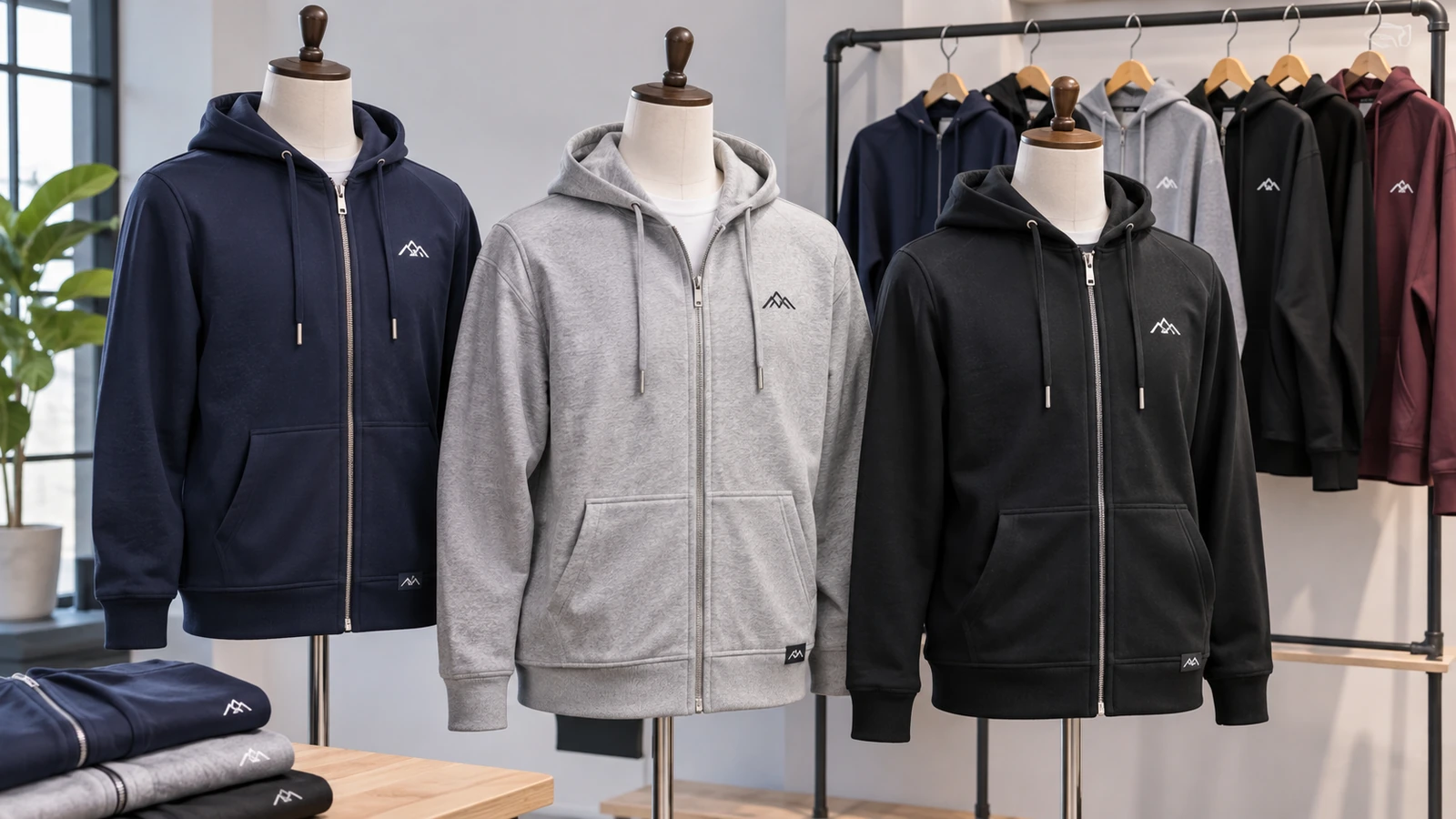
Specify where the hoodie will actually be worn
Clarify whether the team needs an extra layer in air-conditioned spaces, on evening commutes or in a controlled working area. A hoodie is not automatically a substitute for specialised protective clothing. Check company safety and hygiene policies before ordering, particularly around machinery, food handling and high-visibility requirements. A general casual garment may not be permitted in every work zone.
For the purchase approval, write permitted work areas and prohibited tasks into the purchasing brief. This is worth recording before the design is signed off, because an otherwise comfortable hoodie can fail a workplace policy test.
Measure over the intended underlayer
A sample that fits well over a T-shirt may pull across the shoulders when worn over a polo or long sleeve. Ask employees to try the hoodie with their actual uniform layers. Check how sleeves behave when arms reach forward and how the hem sits during bending. Garment dimensions should be compared with an existing successful size, not guessed from labels.
A useful verification step is to test one size below and above the likely size on two body types. The practical reason for that check is that buying by usual casual size alone creates complaints about tight shoulders and bulky waists.
Decide between full zip and pullover
Full-zip styles can be easier to remove during temperature changes and may allow staff to keep a name badge or shirt visible. Pullovers can have fewer front interruptions for artwork but may be less convenient when layering repeatedly. Look at pocket access, neck opening and drawstring policy as well as appearance.
During the production review, have a shift supervisor test donning and removing the sample during normal tasks. Skipping this step can cause a surprisingly expensive problem: a logo choice can accidentally take priority over the more important clothing function.
Plan logo areas without compromising movement
Print film or dense embroidery near a high-stretch seam may feel uncomfortable or behave poorly after repeated movement. A small emblem on the chest is common, but check proximity to zip edges and pocket openings. For a large back graphic, examine drape and how the design appears when the hoodie is bent or layered under another garment.
The team should also approve the application on a garment in the actual size range, not only a flat mockup. Treat this as part of the specification rather than an informal preference, since a decoration that looks centred on a tabletop can appear distorted while worn.
Check care and drying logistics
Hoodies are bulkier than lightweight polos and can take longer to dry. Fabric composition, fleece finish and decoration determine care limits. If staff need clean layers every evening, allow for laundering and backup stock. A pilot wash can show cuff changes, zip waviness or print behaviour early, before hundreds of garments enter circulation.
Before a supplier prepares the final proof, test washing, air drying and normal handling on a complete decorated sample. The risk is operational as much as visual: insufficient dry time can push employees towards unsuitable heat settings.
Order controlled spares rather than guessing
Record staff sizes, garment model, shade, logo revision and department allocations. A small buffer of common sizes may be useful if personnel changes frequently, but base it on actual issue history. Make clear who authorises a replacement and whether the old garment must be returned. This prevents random purchases that erode consistency.
For a repeat order, create an inventory record for issued, spare, exchanged and damaged garments. Keep the result with the approved sample, since untracked stock makes a successful initial order expensive to maintain.
Practical example: making the decision
A hypothetical night-shift support team works in both a cooled office and a permitted packing area. Procurement tests a pullover and full-zip hoodie over the polo that employees actually wear. Some testers find the pullover warm but awkward to remove quickly, while others prefer it for casual use. The organisation selects a full-zip model for the authorised roles and chooses a small logo placed clear of the fastening. Supervisors explicitly exclude work near equipment where loose clothing is prohibited. One decorated garment is washed and worn during a short trial, then the final size chart is circulated. Spare-stock quantities follow the observed sizes rather than an arbitrary equal split. The resulting purchase sheet contains workplace use limits, garment code, colour, decoration dimensions and exchange rules, making later staff additions much less uncertain.
Additional approval considerations
Layering comfort is also affected by the position of the hood when the worker sits or wears a permitted outer layer. Test whether the hood pushes against a chair, catches under a collar or covers identification on the back. These are ordinary wear tests, not reasons to assume a hooded garment is approved for all operational tasks.
Where a company has multiple shifts, arrange a fitting window that includes the smaller evening group rather than relying on daytime volunteers. Allowing each department to select independently can generate incompatible colours and size references. A consolidated sample approval avoids a later situation where the same team wears different garment models under one uniform policy.
- Write permitted work areas and prohibited tasks into the purchasing brief.
- Test one size below and above the likely size on two body types.
- Have a shift supervisor test donning and removing the sample during normal tasks.
- Approve the application on a garment in the actual size range, not only a flat mockup.
- Test washing, air drying and normal handling on a complete decorated sample.
- Create an inventory record for issued, spare, exchanged and damaged garments.
An additional control is to write permitted work areas and prohibited tasks into the purchasing brief. Combine that check with a final handover step: create an inventory record for issued, spare, exchanged and damaged garments. Keep both results with the dated approval sample so a replacement order uses the same reference. Where the material, delivery address or production technique changes, ask for a fresh confirmation rather than assuming that an old quotation covers the new combination.
Frequently asked questions
Are hoodies suitable for every factory role?
No. Check workplace clothing, machinery and safety requirements first.
Should employees size up?
Try the sample over the intended uniform layer rather than applying a universal rule.
Full zip or pullover for shifts?
Choose by removal frequency, badge visibility, temperature changes and approved branding areas.
Do hoodies require special washing?
Follow each garment and decoration label; test the complete item before adopting a team routine.
For a quotation based on the actual garment, print method, quantity and delivery location, review UniformJohor services and use the official enquiry page. Prices, methods, production schedules and minimum quantities must be confirmed for the specific job.